
RS232 and RS485 are common serial communication interface standards. They have obvious differences in electrical characteristics, communication methods, transmission distance, application scenarios, etc.Here is a comparison for you:
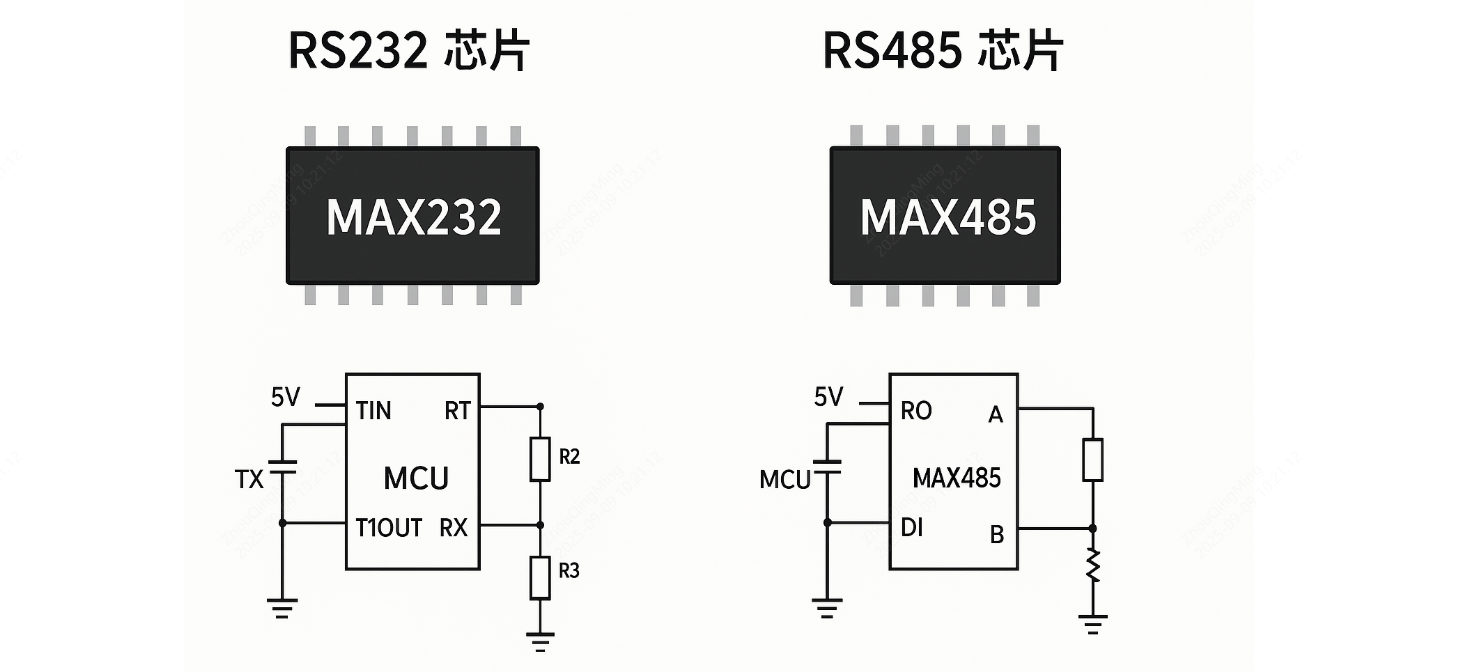
1. Electrical characteristics
RS232
- Single-ended signal (ground reference)
- Logic 1≈−3V−15V, logic 0≈+3V+15V
- easily disturbed
RS485
- Differential signal (symmetrical transmission between A/B lines)
- A−B differential voltage >+200mV means 1, <−200mV means 0
- Strong anti-interference ability
2. Communication method
RS232
- Point-to-point communication (1 to 1)
- Does not support multi-machine mounting
RS485
- Support multi-point bus (theoretically up to 32 transceivers, expandable to hundreds).
- Commonly used in industrial buses with one master and multiple slaves.
3.Transmission distance & rate
RS232
- The maximum distance is about 15m (up to tens of meters at low speed)
- Typical rate: tens of kbps
RS485
- The maximum distance is about 1200m (at 100kbps)
- Maximum speed up to 10Mbps (short distance)
4. Interface and wiring
RS232
- Commonly used DB9/DB25 interface
- At least 3 wires (TX, RX, GND)
RS485
- Commonly used terminal blocks or RJ45
- 2 wires (half duplex) or 4 wires (full duplex)
5. Application scenarios
RS232
- Computer serial ports, modems, old-fashioned instruments and equipment
- Suitable for short distance, point-to-point transmission
RS485
- Industrial automation, PLC, instrumentation, building control, security monitoring
- Suitable for long-distance and multi-point communication
Summary and comparison
Features | RS232 | RS485 |
Signal type | single ended | difference |
Communication method | peer to peer | Multiple points (1 master, multiple slaves) |
Transmission distance | About 15m | About 1200m |
rate | ≤ 115kbps | ≤ 10Mbps |
Anti-interference ability | weak | Strong |
Typical applications | PC serial port, modem | Industrial control, PLC, monitoring, building control |